A state with no single market centre
Madhya Pradesh does not trade through one big city. Bhopal is the capital and Indore is the largest city. Jabalpur, Gwalior, Ujjain and Sagar follow, and Dewas sits beside Indore. Each has its own bazaar and its own habits. Heavy industry is spread out too: Pithampur near Indore has about 1,500 units, Mandideep south of Bhopal has more than 650, Govindpura is Bhopal's northern industrial zone, and Jabalpur has defence factories such as the Gun Carriage Factory at Khamaria.
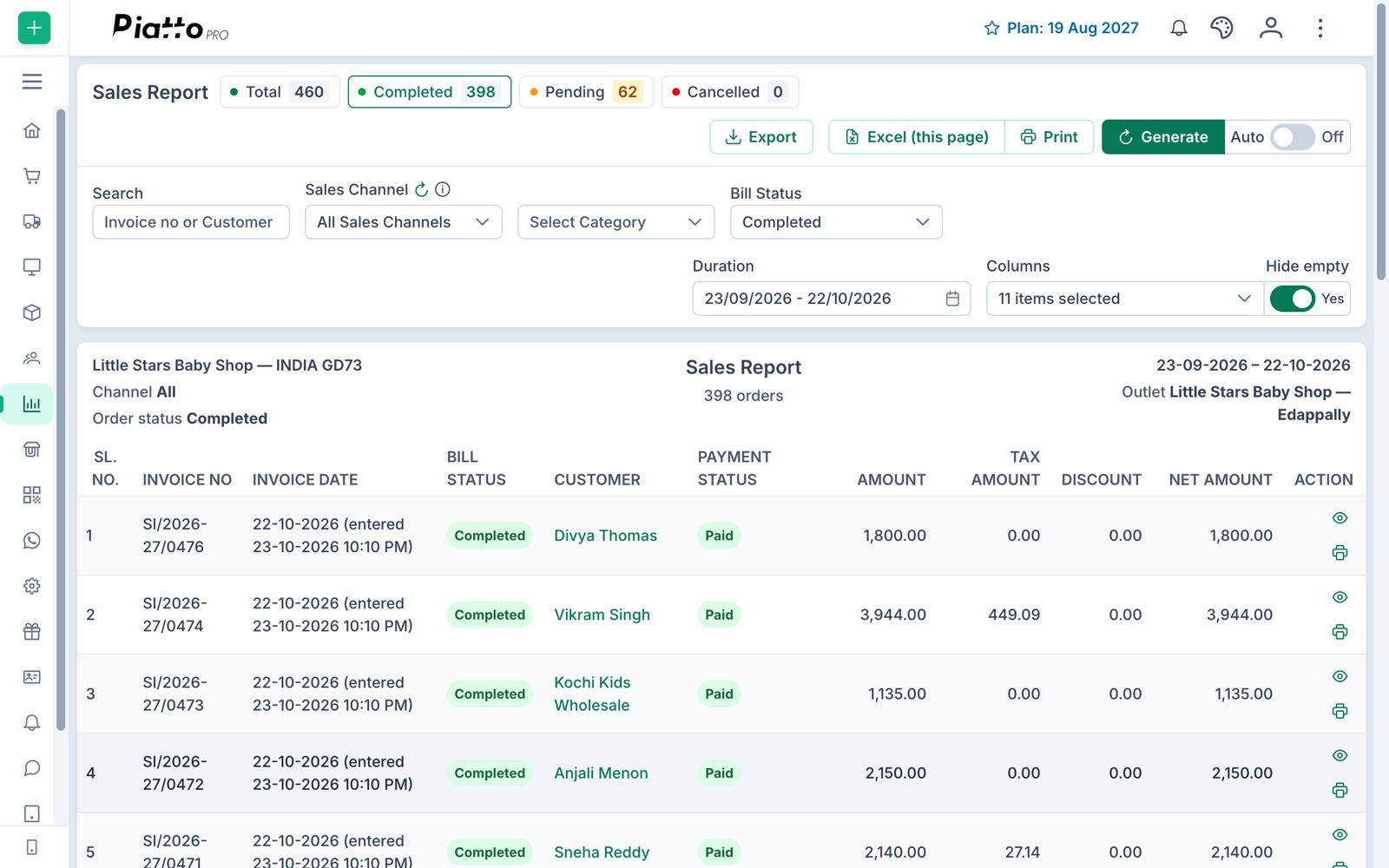
Underneath the cities is farming. The state is listed as the top producer of soybean, gram, pea and garlic, and it has the most pulses and oilseeds in the country. A shop in a small town sells to farm families as much as to office workers. Piatto Pro gives that shop a tax invoice for every sale, a stock count that matches the shelf, a ledger for those who buy on credit until harvest, and a till that carries on without the internet. Madhya Pradesh is GST state code 23, so a sale inside the state is split into CGST and SGST and a sale to another state carries IGST.
May heat and the monsoon months
Summer runs from March to June, and May is the hot month. In the north of the state, Gwalior, Morena and Datia can pass 42 degrees. Bhopal recorded 46.7 degrees in May 2016, and Indore's record high is 46.0 degrees, also in May. A shop under a tin roof in that month has a tired till and a tired owner.
The monsoon arrives around mid-June and brings most of the rain until September; the east and south-east get the most. Indore averages about 955 mm a year and Bhopal about 1,101 mm, mostly in those months. Bhopal sees frequent thunderstorms and flooding in the rains. A POS that bills offline and syncs later keeps the counter selling when a storm takes the signal; it still needs power at the device, so keep a charged tablet or a small UPS nearby. Reports and accounts wait for the connection.