Billing software for shops, restaurants and wholesalers in Saudi Arabia

VAT invoices at 15% with the buyer's VAT number, barcode billing and stock for counters in Riyadh, Jeddah, the Eastern Province and beyond. The POS keeps billing when the network drops. Ask us about ZATCA e-invoicing before you buy.

No card needed. Cancel anytime.

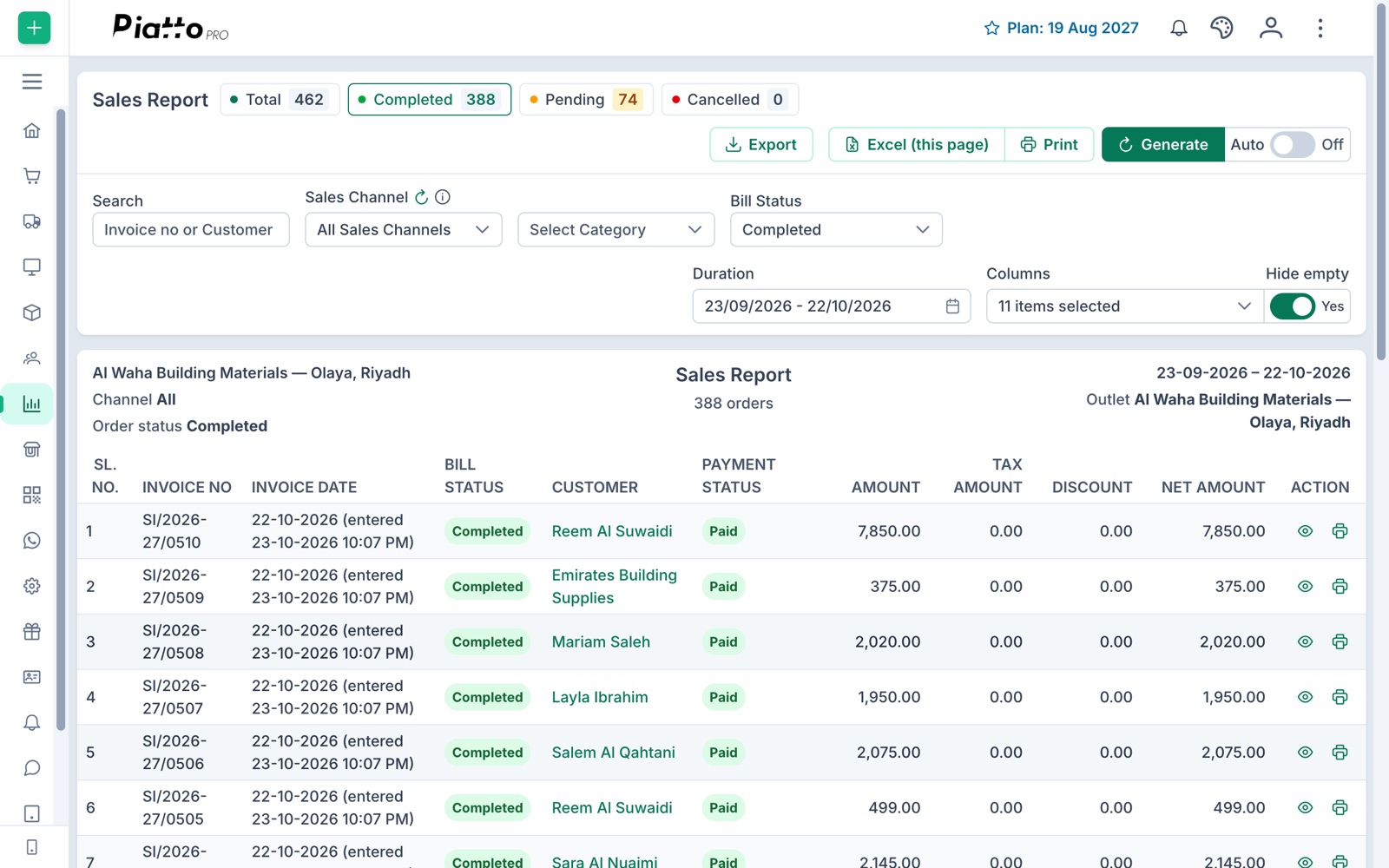
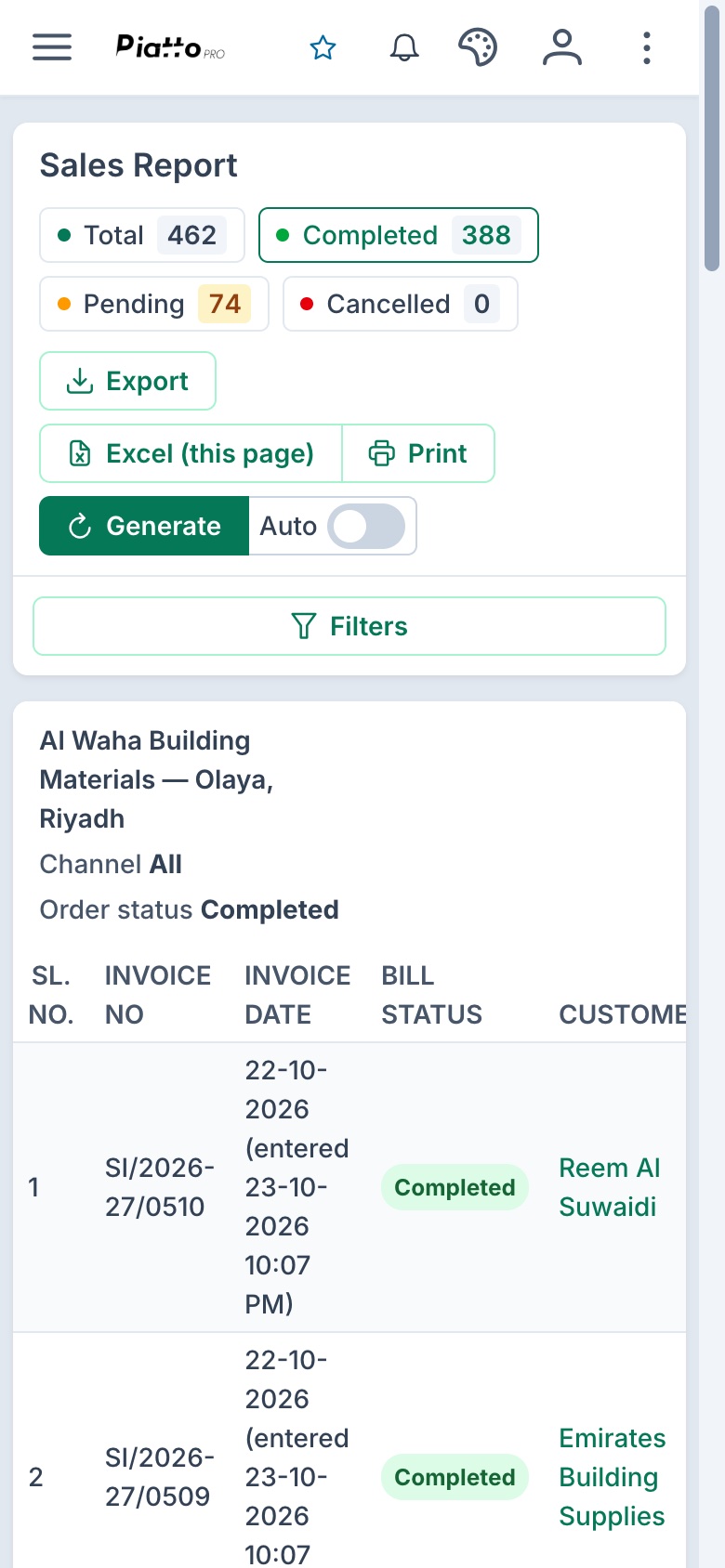
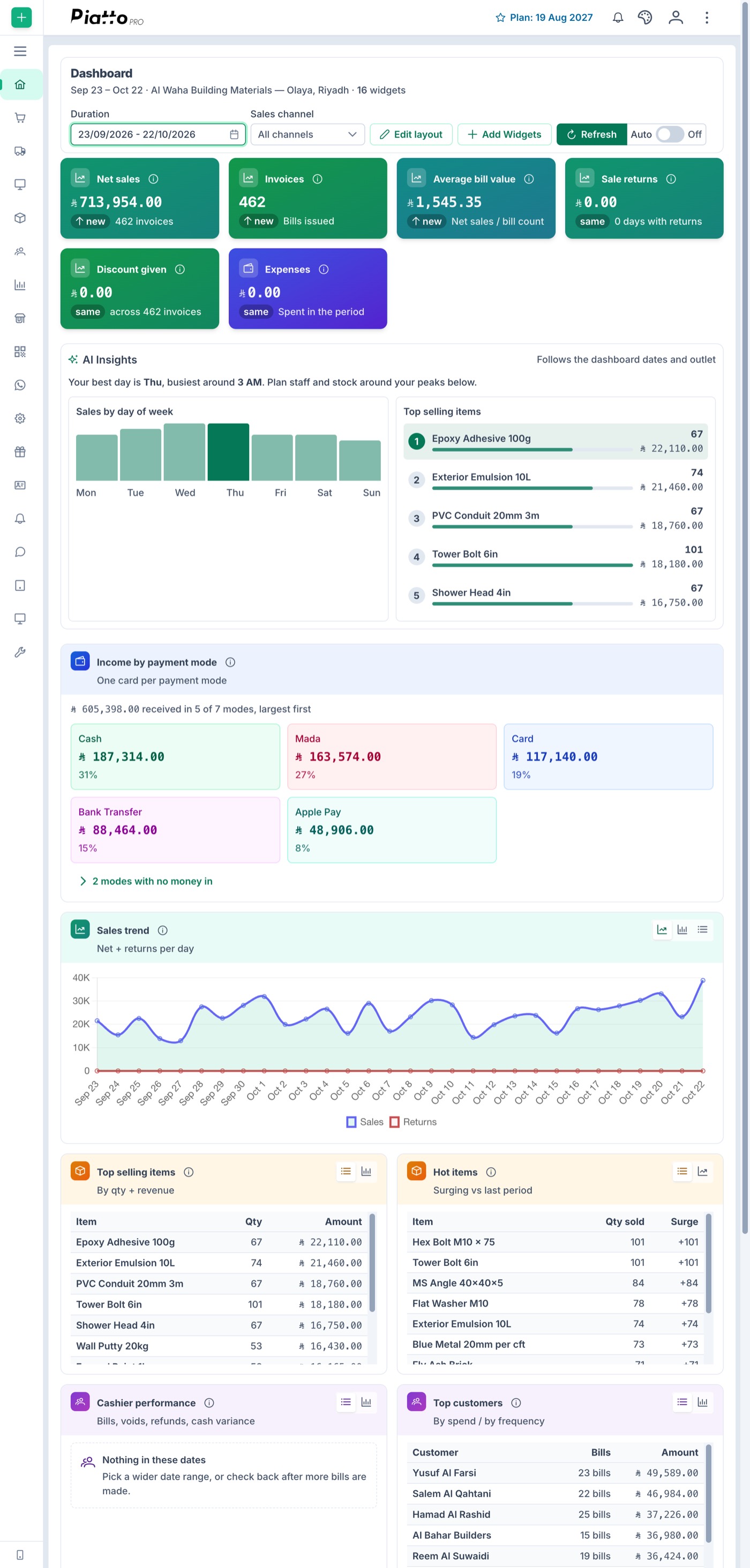
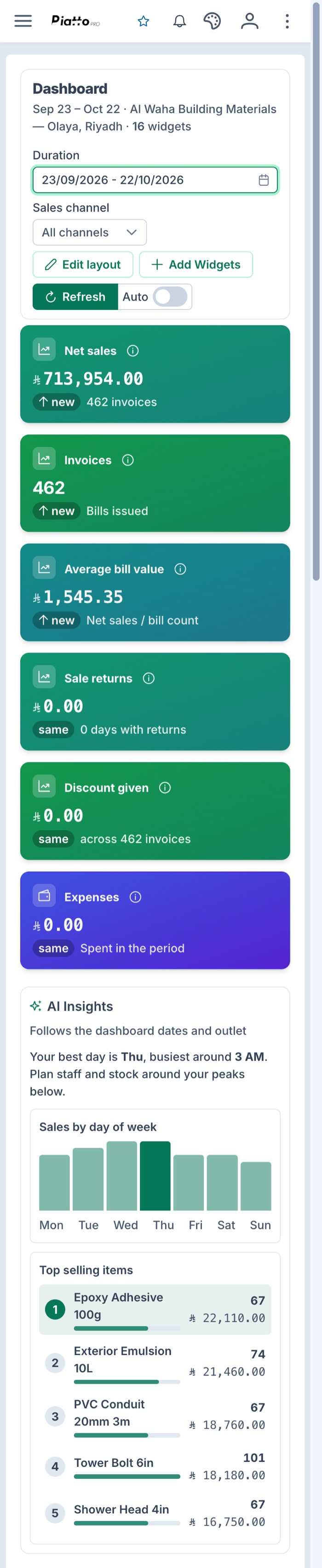
Dashboard with net sales, invoices and top selling items

Sales, payments and best sellers over the last 30 days.

See a shop's screens

A sample shop with real bills and tax. Your items and prices go in the same way.

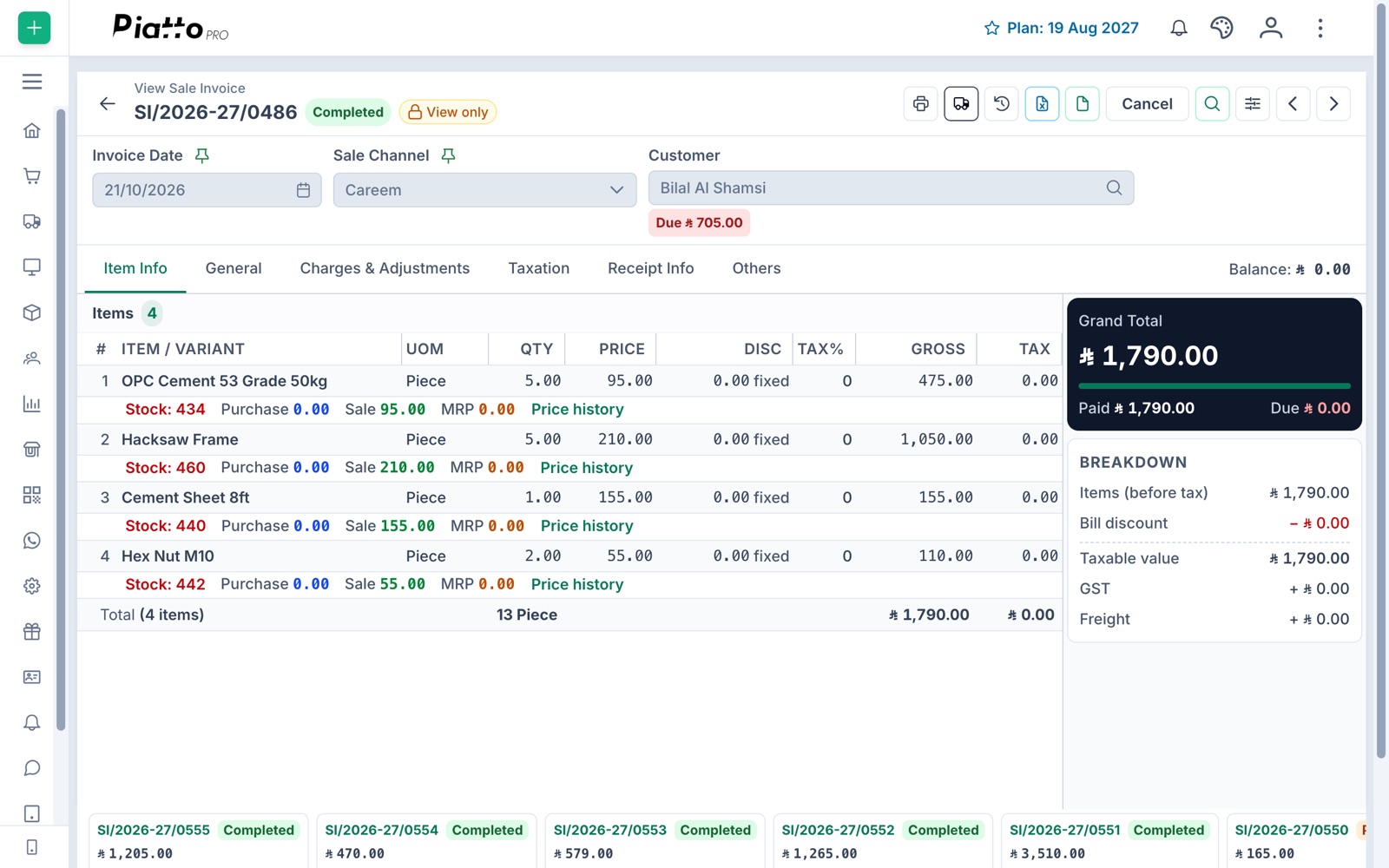
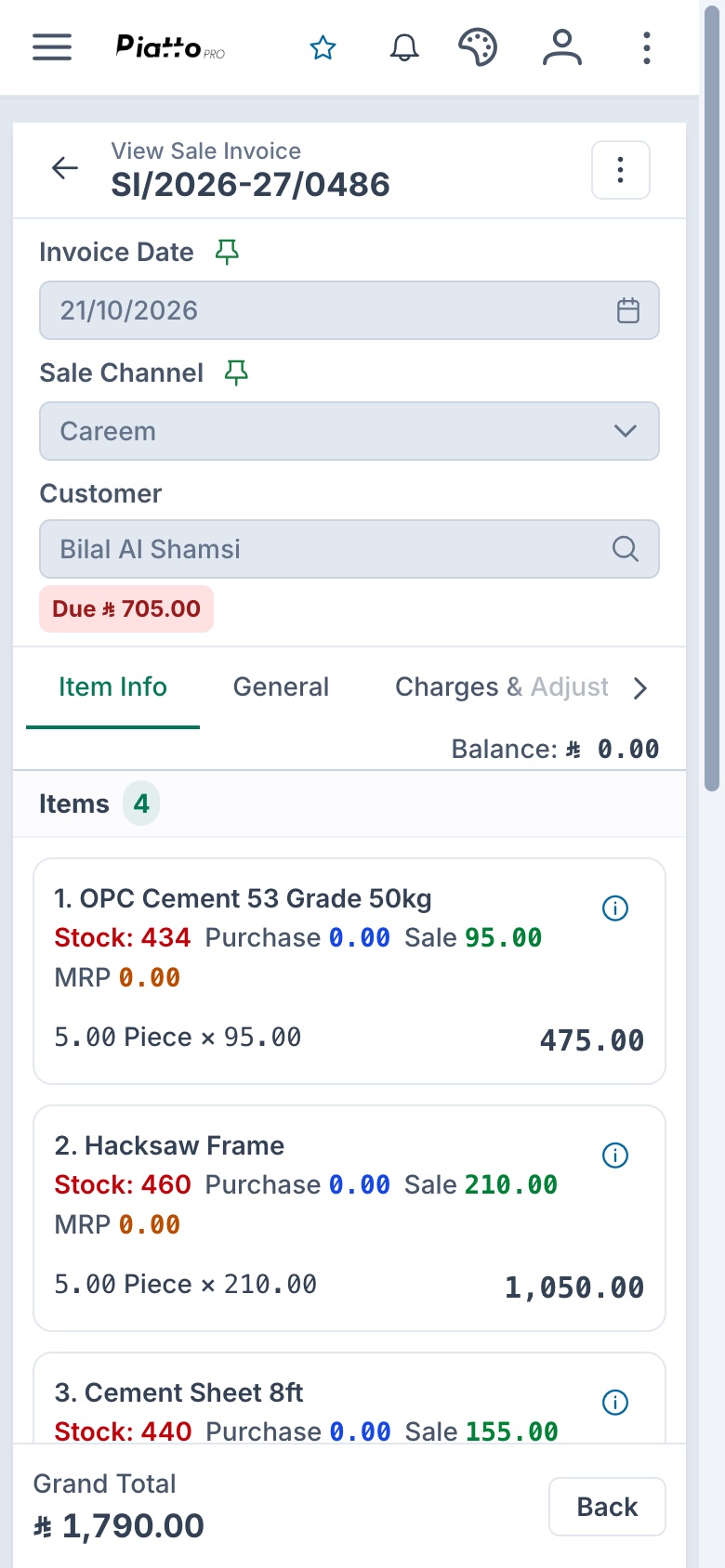
A tax invoice for a shop with the tax on every line
A bill with the tax worked out on every line.

One kingdom, three very different ways of selling

Saudi retail is not one market. In Riyadh the old trade still runs through Souq Al Zal in ad-Dirah, where rugs and oud have been sold for well over a century, while the modern city sells through malls and the Olaya district. In Jeddah the Red Sea port and the old souks of Al-Balad have always lived off pilgrims passing through on the way to Makkah. On the Gulf coast, Dammam, Khobar and Dhahran sell to an oil, port and industrial workforce. A till that suits one of these may not suit the others.

Piatto Pro is a billing, stock and accounts product with an offline-first POS. Saudi Arabia charges VAT at 15%, collected by the Zakat, Tax and Customs Authority (ZATCA). Every bill can carry the buyer's VAT number, and reports are ready for whoever prepares your return. E-invoicing is the point to read carefully. ZATCA's Fatoora rules are rolling out in waves, and Piatto Pro does not support them today. If your business is in a wave, ask us before you buy.

Counters across the kingdom, and what each one asks of billing

These are the kinds of counters that make up Saudi trade, drawn from the three big city regions. The city pages go into streets and districts.

Souq Al Zal and the old trade of Riyadh

Rugs, agarwood and oud, coffee pots, incense burners, antiques and traditional dress.

What billing needs: Few lines per bill but high values and regular buyers. A price per unit lets an item sell by the piece or by the set, and a party ledger shows what a trade buyer still owes.

Al-Balad and Souq Al Alawi in Jeddah

Spices, frankincense, prayer mats, textiles, gold and gifts bought by visiting pilgrims.

What billing needs: Surges when pilgrim groups arrive. Barcode billing and a saved item list keep the queue moving, and a daily sales report shows which days carried the week.

Mall and high-street shops

Fashion, electronics, perfume, abayas, gifts and household goods, in malls such as Mall of Arabia in Jeddah and Marina Mall in Dammam.

What billing needs: Several counters in one shop and several outlets under one owner. Each counter gets its own login, and all outlets sit in one account.

Restaurants, cafes and cloud kitchens

Dine-in, takeaway and orders from HungerStation, Jahez and Talabat.

What billing needs: Kitchen tickets, fast counter billing and delivery-app sales in the same report as walk-in sales, so one number shows the day.

Eastern Province trade and industry (Dammam, Khobar, Dhahran)

Building materials, spare parts, tools and supplies sold to contractors and port and industrial buyers.

What billing needs: Credit accounts and invoices with the buyer's VAT number. The party ledger tracks outstanding amounts, and an Excel import brings in existing customers and opening balances for free.

What a Saudi business has to keep in order

Piatto Pro covers billing, VAT invoices and reports. Licences and filings are for you and your adviser. Rules move, so confirm the current position with the office named in each line.

VAT registration with ZATCA
VAT in Saudi Arabia is 15%, run by the Zakat, Tax and Customs Authority. The usual guides put the mandatory threshold at SAR 375,000 of annual taxable supplies and the voluntary one at SAR 187,500. Check the current figures and the registration steps on the ZATCA site.
Commercial registration
A trading business needs a commercial registration from the Ministry of Commerce, tied to a national address. Piatto Pro does not file it. Keep the certificate with your VAT papers.
Municipal licence through Balady
The licence that lets a shop trade from its premises comes from the Ministry of Municipalities and Housing and is handled on the Balady platform. It is separate from the commercial registration.
Staff registers: Qiwa and Mudad
Employers deal with Qiwa for labour matters and Mudad for wage files. Piatto Pro does not do payroll. It only gives each cashier a separate login.
E-invoicing phases
ZATCA's generation phase began on 4 December 2021 and stopped handwritten or editor-made invoices. The integration phase with Fatoora is rolled out wave by wave, with at least six months' notice to each wave. Piatto Pro does not support the integration yet. Ask us about your business before you buy.
Arabic on shop fronts
A 2008 directive asked shop signboards to be in Arabic, with other languages smaller. A 2026 law-firm note describes a national Arabic language policy that promotes Arabic on signs and invoices. Ask the municipality what applies to your shop.

Heat, dust and floods: why a till has to keep working

Riyadh averages a high of about 43.6 C in August, and dust storms are common. A thick storm covered the capital on 4 March 2022 and another on 17 May 2022, when towers such as Kingdom Centre vanished in grey haze. In Jeddah, floods in January 2011 killed at least four people and cut power in most of the city, after the 2009 floods that killed more than 120. On 24 November 2022 heavy rain closed schools and stranded cars again, and officials promised compensation on the 2009 pattern.

An internet-only till stops in these hours. Piatto Pro's POS bills offline and syncs when the line returns. The device still needs power, so keep a charged tablet or a small battery pack at the counter. Reports and accounts need a connection, but the sale at the counter does not.
Ramadan, Eid, the national days and the pilgrim months

Ramadan shifts trade into the evening. Malls open after the Asr prayer, around 4 pm, and activity peaks between Taraweeh and the pre-dawn meal. The weeks before Eid are another rush. Saudi Founding Day on 22 February and Saudi National Day on 23 September are holidays. Riyadh Season runs from about October to March and Jeddah Season has run in the summer, so shops near those venues feel the crowds.

Pilgrims arriving through Jeddah lift trade in Al-Balad during Hajj and Umrah months. A short routine that suits most counters:

  • Import your item list from Excel before the season. We do it free.
  • Count stock once, so the first busy night starts from a true number.
  • Open a login per cashier and review the daily sales report each night.
  • Set low-stock alerts on fast sellers such as dates, perfume, gifts and abayas.
  • Keep a battery pack and a spare device at the counter for the evenings.
  • Ask us about ZATCA e-invoicing well before the date that applies to you.

Plans for shops in Saudi Arabia

Tablet

SAR 1,000

per outlet / year

Single POS

SAR 1,500

per outlet / year

Windows Plus

SAR 3,000

per outlet / year

Windows Plus Large

SAR 6,000

per outlet / year

Prices exclude tax. Each plan covers one outlet for a year.

What you get

  • Tax invoices with the right rates on every bill
  • Barcode billing and low-stock alerts
  • We move your item list and customers from Excel, free
  • Support 9am to 9pm by phone and WhatsApp, in English and Hindi
  • Cancel anytime

VAT in Saudi Arabia

The standard VAT rate in Saudi Arabia is 15%. Bills carry the VAT and the customer's VAT number, and the VAT summary is ready for your return.

Ask us about ZATCA e-invoicing for your business before you buy.

Billing software near Saudi Arabia

We also serve shops in these places.

Where we bill in Saudi Arabia

We bill for shops across the kingdom. Support answers on phone and WhatsApp in English and Hindi.

  • Riyadh
  • Jeddah
  • Dammam
  • Khobar
  • Dhahran
  • Qatif
  • Diriyah
  • Makkah
  • Madinah
  • Taif
  • Jubail
  • Yanbu
  • Abha
  • Tabuk
  • Buraidah

Questions

What VAT rate does Piatto Pro use in Saudi Arabia?+

The standard rate is 15%, and the rate was raised from 5% on 1 July 2020. Each invoice shows the tax and can carry the buyer's VAT number.

Does Piatto Pro support ZATCA e-invoicing?+

Not today. Ask us about ZATCA e-invoicing for your business before you buy. The integration phase with Fatoora runs in waves based on turnover, and ZATCA gives each wave at least six months' notice.

Can I bill when the internet is down?+

Yes. The POS bills offline and sends the sales across when the connection returns. The device needs power, and reports need a connection.

Do I need VAT registration to use it?+

No. You can bill without a VAT number. Whether you must register depends on your annual taxable supplies, so check the thresholds with ZATCA.

Which delivery apps can I connect?+

HungerStation, Jahez and Talabat sales appear in the same report as counter sales. Ask us if your app is not on the list.

Can I move my items and customers from Excel?+

Yes, free. We import items, customers and opening balances from Excel.

Do you support Arabic?+

Our team answers on phone and WhatsApp in English and Hindi. We do not claim Arabic screens or Arabic invoices.

Message us. We reply in minutes.

9am to 9pm, in English and Hindi.